Early Learning Programmes · Birth to six

Live music for early learning services and kindergartens.

Montessori-informed sessions planned around the age group, group size and the rhythm of your day.

Children meet live guitar, ukulele, percussion, movement, song choice, listening and musical pattern within a recognisable structure. The programme changes as the children change, with materials, pace and musical demands adapted to each group.

North Brisbane Birth to six Recurring service and school programmes
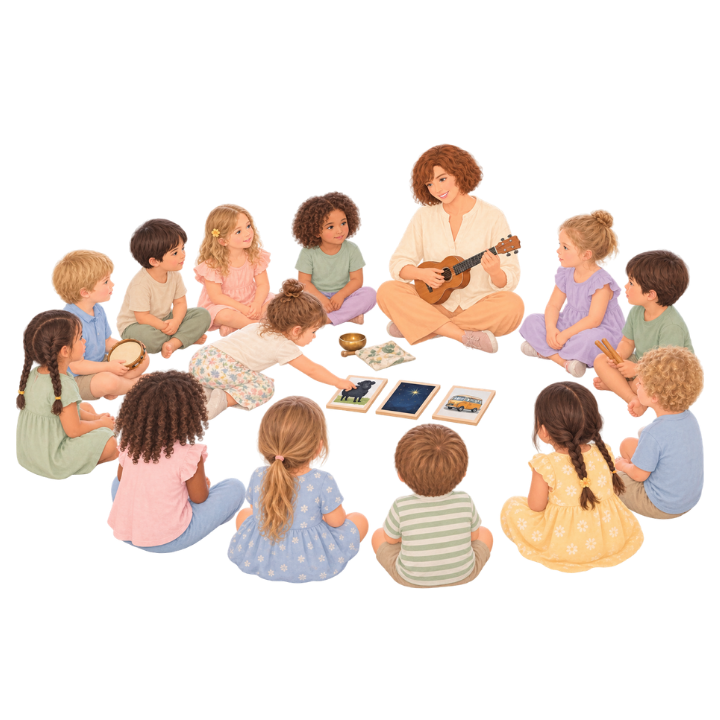
Kym leading an early learning music circle as a child chooses from prepared song cards
Montessori-qualified BA (Hons) Montessori Early Childhood Studies, First Class
Child-safe practice Current Blue Card and Child Protection training
Insured $20m Public Liability and Professional Indemnity cover
Music education Orff Schulwerk Level 1; two years of Kodály methodology study, with ongoing application in early childhood music practice and continued musicianship development
Programme at a glance

The practical shape, before the pedagogy.

Every service has different enrolments, rooms, work cycles and available time. These are the parts that stay clear while the final programme is designed around your setting.

Ages Birth to six
Delivery On-site at your service or kindergarten
Format Age-responsive groups, with compatible groups combined where it makes sense
Frequency Recurring programmes, often planned across a term
Timing Built around group size, developmental stage, room rhythm and the visit window available
Educators Remain present and maintain supervision, ratios and service procedures
Documentation Brief learning notes available where agreed
Programme fee Quoted individually around enrolments, structure, timetable and programme length
One visit might look like this

This is an example rather than a fixed timetable. Your actual group sequence is built from the children, rooms, available time and budget.

Infantsabout 10–12 min voice · gentle instruments · listening · shared attention
Toddlersabout 12–20 min movement · beat · gesture · visible choices · percussion
3–6 yearsabout 25–30 min singing · rhythm · movement · solfa · instruments · child contribution

If you already have a programme budget, tell me. I can suggest how groupings and session lengths could work sensibly within it.

One programme, different developmental needs

The music changes with the children.

An infant session calls for a different pace, scale and musical experience from a 3–6 group. Materials, movement, musical demands and session length change with the developmental stage and the group in front of me.

Infants · birth–15 months

Sound, connection and shared attention

Voice, gentle live instruments, simple percussion, repetition and quieter listening are offered at a smaller scale and an unhurried pace.

Musical focus: sound awareness · early melody · simple pulse · imitation · visual and auditory attention

Toddlers · 15 months–3 years

Movement, choice and emerging language

Steady beat, singing, gesture, percussion and visible song choices give children practical ways to join, repeat and influence the session.

Musical focus: beat · movement · turn-taking · emerging language · choice-making · familiar musical patterns

Kindergarten / Cycle 1 · 3–6 years

Musical foundations, creativity and ensemble work

Older groups can extend into solfa, rhythm work, movement, ensemble playing, musical games, pattern and simple composition.

Musical focus: pitch · rhythm · memory · coordination · creativity · ensemble skills · child leadership

Session timing is agreed with the service. Younger groups usually need a shorter musical sequence; older groups can sustain more. Group size, room rhythm and the wider timetable all matter.

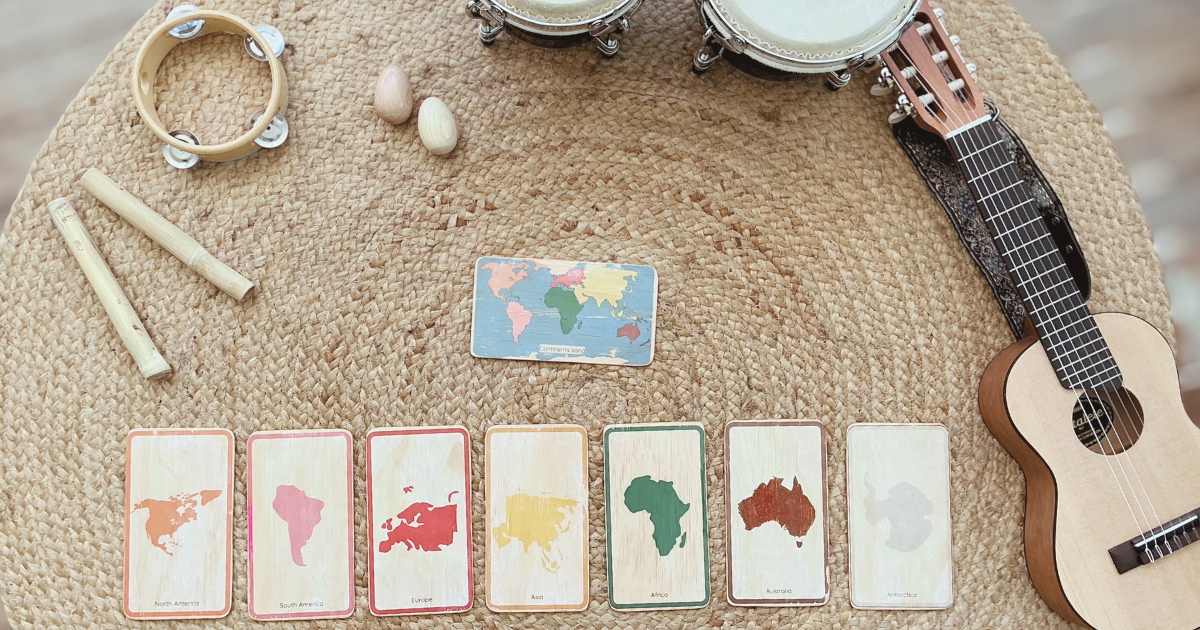
Montessori colour-coded continent song cards and music materials prepared for an early learning session
A recognisable session rhythm

A clear structure, without a fixed script.

A familiar beginning and ending help children know where they are. Inside that frame, the group can move, choose, watch, repeat and change direction.

01

Gather. A familiar opening brings the group into the musical space together.

02

Listen and breathe. Tingsha chimes and a slow breath create a brief shared listening moment.

03

Greet and choose. Greeting songs, photographic song cards and visible materials help children recognise what is available and influence what comes next.

04

Play and move. Guitar, ukulele, percussion, voice, movement, gesture and Key Word Sign using Auslan signs can be woven in where useful.

05

Close. Instruments are returned and a familiar farewell helps the group move back into the rest of the day.

Across a recurring programme

Each visit has somewhere to go.

A recurring programme is not the same session repeated each week.

Familiar songs, rituals and materials create continuity. Observation of the group then informs what is repeated, extended, simplified or introduced next.

01
Meet the group

Establish familiar rituals, notice participation and learn what catches the children’s attention.

02
Repeat and extend

Return to musical ideas children recognise while adding a little more challenge, variation or responsibility.

03
Follow what emerges

A rhythm, song, movement, project or children’s idea can become material for later sessions.

04
Build musicianship

As familiarity grows, children can take more responsibility through choosing, remembering, coordinating, leading and creating.

Working with your service or school

The programme fits around the day you already run.

Montemusic brings the musical planning, instruments and prepared materials. Your educators remain the people who know the children, the room and the rhythm of the day. The strongest programmes use both.

Montemusic brings

  • live acoustic instruments and prepared musical materials
  • planning responsive to the age group and group size
  • a consistent session rhythm with genuine child choice inside it
  • reflection and adjustment as I get to know each group
  • brief learning notes where documentation has been agreed

Your educators remain part of the session

  • remain present and maintain supervision, ratios and service procedures
  • support individual children and continuity of relationships
  • share relevant interests, observations or current project work
  • join the music where helpful and carry familiar songs or rituals into the week
  • use any session notes within their own planning and documentation processes
TimetableSessions can be sequenced around room routines, work cycles and the time available.
SpaceIndoor, outdoor or undercover delivery can be planned with the service.
ContinuityRecurring programmes allow songs, musical ideas and group familiarity to build over time.
What educators have noticed

Music that connects with children.

“Kym is a great educator whose warmth and energy create an inviting atmosphere for children. Her passion for music shines through in every session, captivating the children and fostering a love for learning. Having worked alongside her, I’ve seen firsthand how her engaging music sessions ignite joy and creativity in her students. Kym truly has a gift for connecting with children, making her an invaluable asset to any educational setting!”

Natasha CondonEarly Years Teacher, Brisbane

“Kym's musical talent and general aura always excelled and never disappointed. Always well received when adapted to her classes for the children at Chalong International Kindergarten and School, Phuket.”

Daniell PillingFounder and Director, Chalong International Kindergarten and School, Phuket
EYLF and QKLG connections

The music stays playful. The learning stays visible.

These connections are built into how Montemusic is prepared and delivered. Children choose from visible materials, repeat and refine patterns, move, listen, care for instruments, contribute ideas and work within a shared sequence. Montessori practice and music education meet naturally across the frameworks.

EYLF outcomes

Open an outcome to see how the programme supports it in practice.

EYLF Outcome 1: IdentityOutcome 1 · IdentityHow this is supported

Visible song choices, familiar greeting songs, child-led turns and space to join at their own pace support agency, confidence and belonging.

EYLF Outcome 2: Children are connected with and contribute to their worldOutcome 2 · ConnectednessHow this is supported

Shared instruments, group rhythm, care of materials and songs connected with people, places and the natural world invite children to contribute to something beyond themselves.

EYLF Outcome 3: Children have a strong sense of wellbeingOutcome 3 · WellbeingHow this is supported

Movement, breath, listening rituals and predictable transitions support physical participation, coordination and a settled way of moving through the session.

EYLF Outcome 4: Children are confident and involved learnersOutcome 4 · Active learningHow this is supported

Children repeat patterns, remember sequences, test sounds, improvise and revisit ideas, building persistence, curiosity and problem-solving through active music-making.

EYLF Outcome 5: Children are effective communicatorsOutcome 5 · CommunicatingHow this is supported

Children communicate through singing, rhythm, gesture, photographic song cards, musical language and Key Word Sign using Auslan signs where useful.

QKLG

For kindergarten groups, the programme can extend these same foundations through more complex musical roles, patterns, ensemble work and creative decision-making.

QKLG: IdentityIdentityHow this is supported

Children choose, lead, improvise and take musical roles, giving them practical ways to express preference, capability and growing confidence.

QKLG: ConnectednessConnectednessHow this is supported

Ensemble work, shared materials, turn-taking and songs connected with culture, place and nature help children participate in a group and consider the wider world.

QKLG: WellbeingWellbeingHow this is supported

Movement, coordinated instrument play, breath and quiet listening give children opportunities to use their bodies confidently and experience changing levels of energy and attention.

QKLG: Active learningActive learningHow this is supported

Solfa, beat and pitch patterns, memory games, improvisation and simple composition invite children to investigate, predict, practise and create.

QKLG: CommunicatingCommunicatingHow this is supported

Voice, rhythm, solfa hand signs, gesture, visual song choices, musical vocabulary and collaborative play give children several ways to express and interpret meaning.

Where agreed, brief session notes can be provided for educators to draw on within their own planning, reflection and documentation. They are not intended to replace the service's own observations or curriculum decision-making.

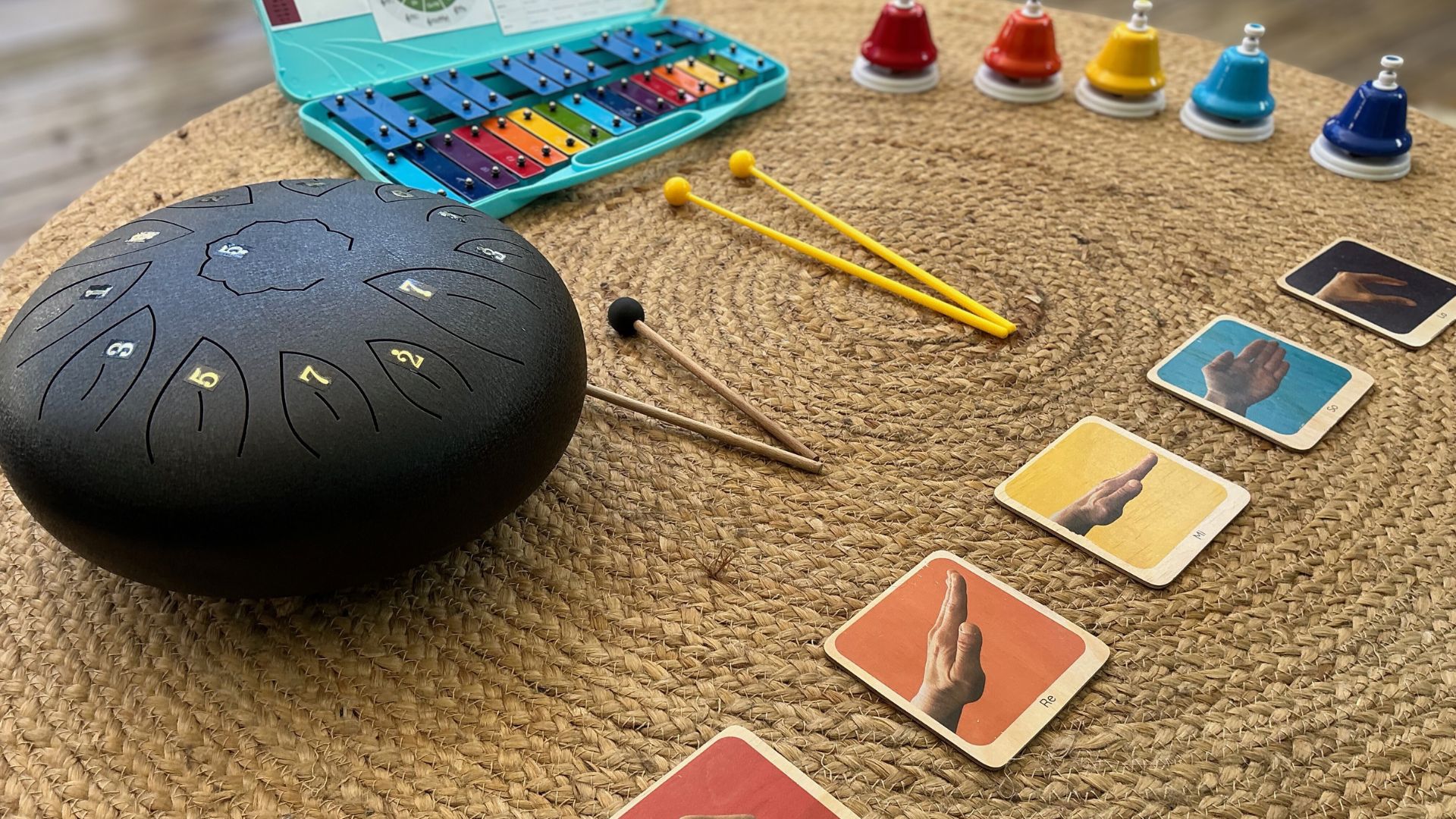
Tongue drum, bells, glockenspiel, mallets and solfa cards prepared for music work
Pedagogical foundation

Intentional teaching inside active music-making.

Musical understanding begins in active experience before it becomes abstract.

Montemusic draws from Montessori practice and established approaches to early music education. Across these approaches, children first meet musical ideas through voice, movement, instruments, repetition and direct experience, with understanding becoming more conscious over time.

Montessori

Observation, readiness, independence, order, respectful modelling, choice and freedom within clear limits.

Kodály

Voice, listening, solfa and musical pattern build aural understanding through a sequence that moves from hearing and singing towards reading, writing and creating.

Orff

Speech, movement, body percussion, instruments and improvisation let children explore rhythm and pattern through active, progressively organised music-making.

Dalcroze

Eurhythmics connects listening and movement so pulse, tempo, phrasing and musical form are experienced through the body before becoming abstract concepts.

National Quality Standard

How the programme connects with the NQS.

The programme connects most directly with educational programme and practice, the learning environment and relationships with children. Other Quality Areas shape how Montemusic works safely and collaboratively within your service.

Direct programme connection · QA1

Educational program and practice

Sessions respond to children's interests, choices and participation. Educators can draw on observations from the music programme within their own planning, reflection and documentation.

Supporting connection · QA2

Children's health and safety

Predictable routines, calm transitions and age-appropriate instrument use are built into the session. The programme operates within the service's own health, safety and supervision procedures.

Direct programme connection · QA3

Physical environment

Materials are prepared so children can see, reach, choose and return what they use. Indoor, outdoor and undercover spaces can be adapted to support participation without requiring a separate specialist room.

Service responsibility · QA4

Staffing arrangements

Montemusic is an external programme. Service educators remain present with the children, maintain ratios and supervision, and provide the continuity of relationships that sits around the session.

Direct programme connection · QA5

Relationships with children

Respectful pacing, genuine choice, observation and different ways of joining help protect each child's dignity. Children can participate through singing, movement, watching, choosing or returning when they are ready.

Supporting connection · QA6

Collaborative partnerships with families and communities

Where useful to the service, familiar songs, children's interests and brief session notes can give educators material to share with families or extend within the wider programme.

Service responsibility · QA7

Governance and leadership

Professional documents, insurance, child-safety requirements and agreed service arrangements are provided so the programme can sit clearly within the service's own governance, risk and quality-improvement processes.

Programme enquiry

Tell me about your rooms, groups and weekly rhythm.

You do not need to design the programme before getting in touch. Start with the children you have, the time available and what you would like music to add to the service. If you already have a programme budget, include it and I can suggest a structure that works within it.

Age groups or room names

Approximate number of children in each group

Preferred day or time window

Any current interests, routines or programme priorities

I can suggest a workable programme structure from this information. Exact session timing can be agreed afterwards.